
Recap: Support for the AV1 codec has grown considerably since its launch in 2018. Large and small platforms quickly adopted the format to minimize bandwidth consumption while preserving image quality. Netflix, a primary backer of AV1, plans to continue expanding the codec across its applications while also utilizing it and its upcoming successor for new ventures.
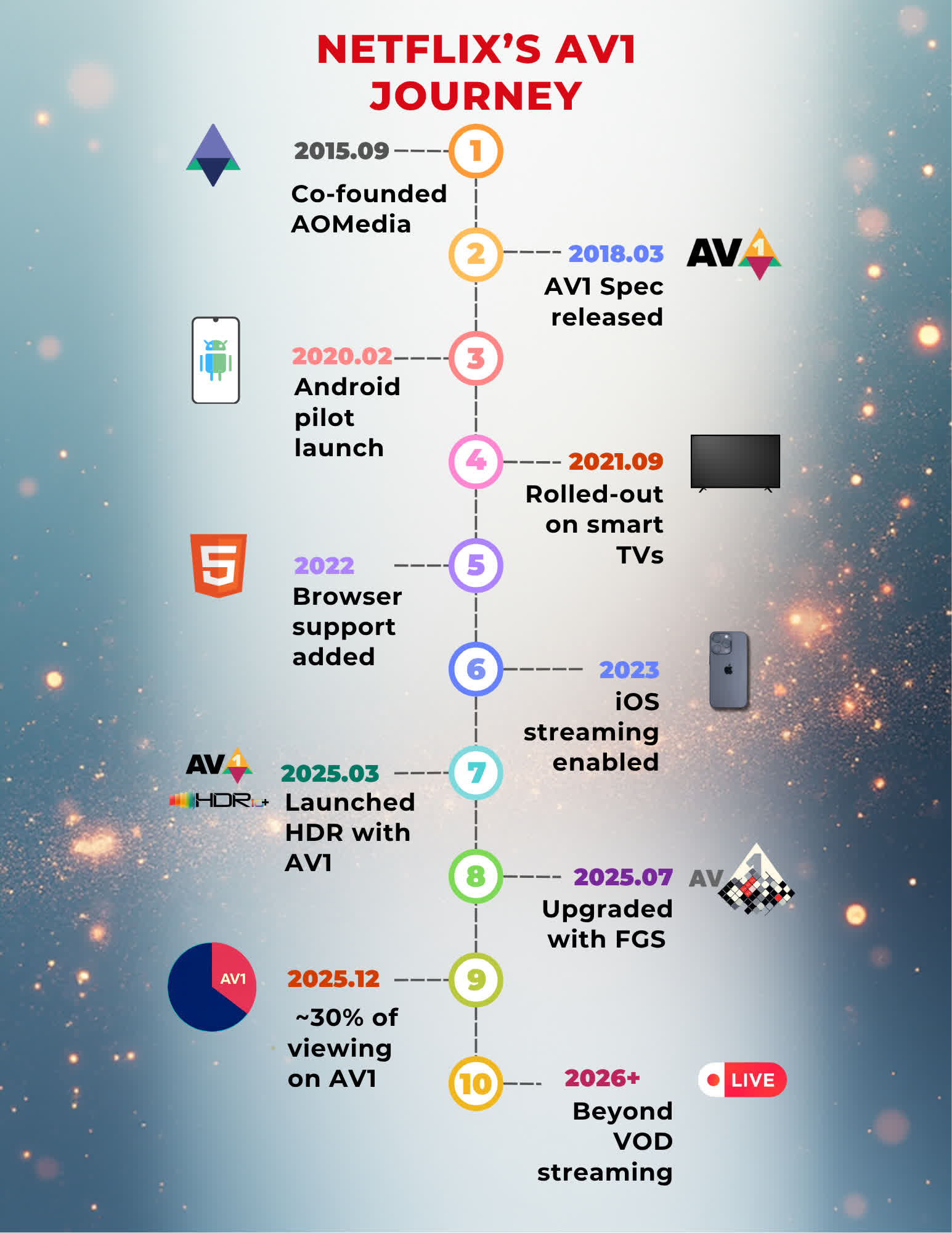
Netflix recently confirmed that the AV1 codec is responsible for nearly one-third of its streaming content. In a lengthy Medium post, the company explained how it helped foster the codec's creation and gradually adopted it across various devices.
The Alliance for Open Media (AOMedia), a consortium that includes Netflix, Amazon, Apple, Google, Microsoft, Mozilla, Nvidia, and other companies, launched AV1 in 2018 as a successor to Google's VP9 format. The codec compresses data more efficiently than the popular H.264 format and is royalty-free, unlike H.265/HEVC.
Decoding and encoding support for AV1 has rapidly spread to modern mobile devices, PC graphics chips, and other hardware over the past several years. During that time, users ranging from large companies to independent content creators have applauded its performance improvements.
Netflix began adopting AV1 software decoding on Android devices in 2020 due to the platform's flexibility and the prominence of mobile devices among streaming audiences. Using the dav1d library, which developers had already optimized for mobile Arm chipsets, the company improved video playback quality for users on cellular networks.
However, bringing AV1 to smart TVs and other home devices required hardware-based decoding, which Netflix gradually certified in collaboration with SoC vendors. The company rolled out the codec on TVs in late 2021, added support for web browsers in 2022, and extended it to Apple's M3 and A17 Pro chips in 2023.

Earlier this year, Netflix rolled out AV1 HDR streaming using HDR10+. The format now covers 85 percent of the company's HDR catalog, and the company plans to transition all its HDR content to AV1 within the next few months.
Netflix explained how AV1 enables smarter film grain integration through Film Grain Synthesis, which strips grain from content before encoding and resynthesizes it in the decoder, lowering bandwidth usage while maintaining quality. The company also hopes the codec will enhance live streaming with customizable graphics overlays and improve cloud gaming performance.
AOMedia recently announced plans to launch AV2 before the end of this year. The new codec will deliver more efficient compression than AV1, supporting technologies such as augmented and virtual reality, split-screen streaming, and more.
The updated codec will come in handy when Netflix starts churning out new and old content from Warner Bros. The streaming titan recently agreed to purchase the production company for a historic $82.7 billion. The acquisition will give Netflix control over popular properties, including Game of Thrones, DC Comics, HBO, and multiple video game studios.