
Looking ahead: Multiple benchmarks have shown that Windows games can sometimes run better on Linux through a compatibility layer, but that advantage often hinges on how well a game or hardware platform is tuned for Linux. New benchmarks meant to mirror Steam Machine-level hardware and mainstream gaming PCs reveal that Linux's biggest gains still come on systems with integrated graphics, while improvements on machines with dedicated GPUs remain uneven. Even so, the results paint an increasingly encouraging picture for Linux gaming overall, and for Valve's ambitions in the space.
Recent benchmarks from Ars Technica show that SteamOS' performance advantage over Windows 11 largely evaporates and sometimes reverses on devices with discrete graphics. Moreover, Valve's Linux distro and compatibility layer appear to worsen performance issues on GPUs with just 8GB of VRAM.
As handheld gaming PCs have multiplied, previous tests have shown that installing SteamOS or a similar Linux variant, such as Bazzite, usually improves performance. This has held true even on the Asus ROG Xbox Ally, despite Microsoft's attempts to optimize Windows for that device.

To take a closer look, Ars benchmarked several games on a selection of Radeon desktop GPUs. The outlet built a test system resembling Valve's upcoming Steam Machine mini-PC, featuring an AMD Ryzen 7 7700X CPU, an Asrock B650 Pro RS motherboard, and 32GB of DDR5-6000 RAM. The Steam Machine's 16GB of system memory is likely more than enough for all of the titles benchmarked.
Although performance varies between games, some trends stand out. The two operating systems are essentially tied in Cyberpunk 2077, Returnal, and Assassin's Creed Valhalla, an impressive showing for SteamOS given the overhead of its translation layer.
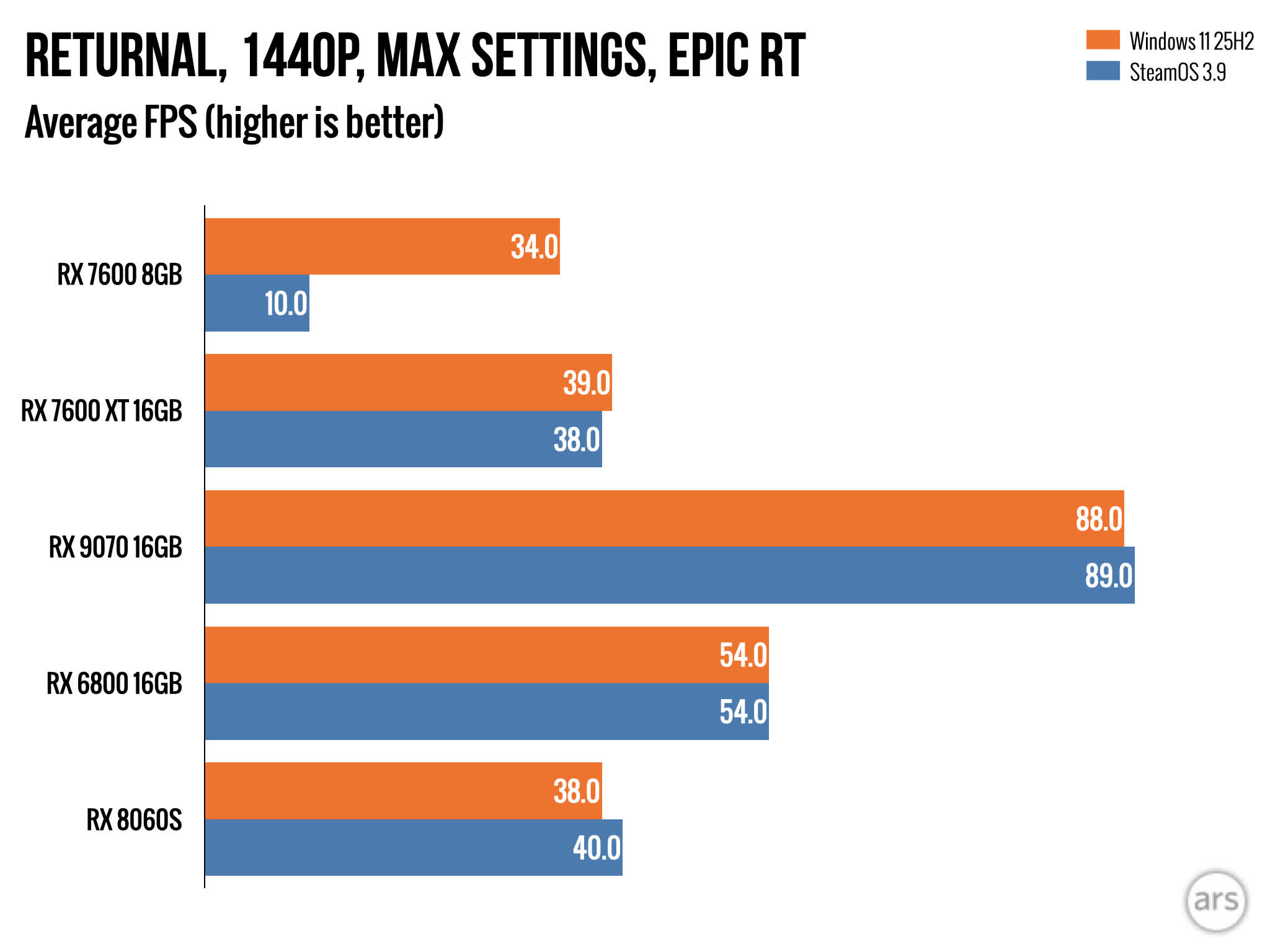
However, the comparison becomes murkier with ray tracing enabled. Windows pulls ahead in Cyberpunk with Ultra RT, while SteamOS keeps pace in Returnal on the Epic RT preset – except on the 8GB Radeon RX 7600. Ray tracing on both titles runs into that GPU's tight VRAM limit, causing the frame rate to collapse.
Forza Horizon 5 shows a unique pattern. On integrated graphics such as the Radeon 780M and Ryzen AI Max 8060S, SteamOS matches Windows, but Windows pulls significantly ahead on all discrete GPUs. Still, the game's Extreme RT setting remains playable on the RX 7600 under SteamOS.
Borderlands 3 is the most consistently Windows-friendly title, even on the 780M and 8060S. It was also one of the few games that favored Microsoft's OS on handhelds in earlier tests.
Overall, the results raise concerns given that the Steam Machine's custom dedicated GPU which closely resembles the RX 7600 and includes only 8GB of GDDR6 VRAM. Valve is aware of the issue and is working on improvements. Ars' testing used the latest SteamOS image, which is currently optimized around the handheld Steam Deck. Valve will likely release updated drivers before launching the Steam Machine early next year.
These benchmarks also help explain why Valve's Linux distro is not yet generally available. An official release for handhelds and desktops is planned, but it will likely require additional internal testing and optimization before it's ready for everyone to enjoy.