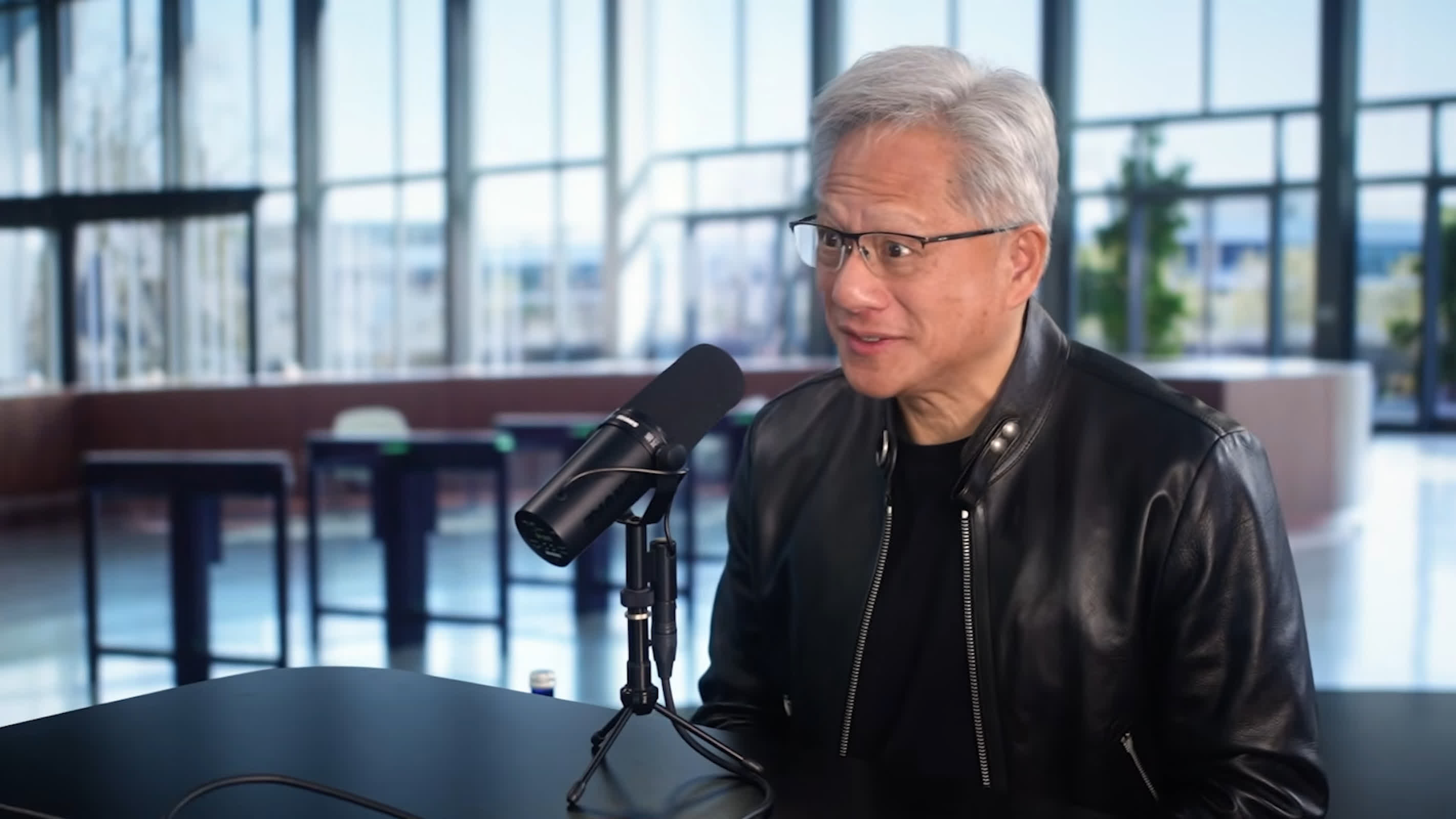
Big quote: Nvidia CEO Jensen Huang declared this week that AGI – short for "artificial general intelligence" – has already arrived, before quickly softening the claim. In one podcast appearance, Huang said flatly, "I think we've achieved AGI," before conceding that today's AI systems may not yet match human capability.
In a separate conversation, he struck a different note, chastising engineers who underuse AI tools and warning he would be "deeply alarmed" if they were not spending enough on the very systems he had just suggested were already intelligent. The tension between those remarks – one heralding the dawn of human-level AI, the other implying it still requires significant human guidance – captures the ambiguity surrounding how close the industry truly is to achieving AGI.
The two appearances came days apart. On March 19, Huang sat down with the All-In Podcast at Nvidia's GPU Technology Conference in San Jose. Three days later, on March 22, his interview with Lex Fridman was released.
In the Fridman interview, Huang said bluntly, "I think we've achieved AGI," referring to the class of systems expected to match or surpass human intelligence. The statement instantly intensified an already polarized debate about what exactly qualifies as "general" intelligence – and whether anyone, including Nvidia, can credibly say it has been reached.
The exchange was prompted by Fridman's own definition of AGI as a system capable of essentially doing your job, including starting, growing, and running a successful technology company worth more than $1 billion.
Asked for a timeline – within five, ten, or even twenty years – Huang didn't hesitate. "I think it's now," he said. His caveat, though, was telling: "You said a billion," he added, "and you didn't say forever" – framing AGI not as a durable human-level mind, but as a momentary commercial threshold. Fridman noted that Huang's definition could "get a lot of people excited," and indeed it did. Tech leaders and researchers have long disagreed over whether current AI systems truly demonstrate general intelligence or just mimic fragments of it.
– knox (@justinknox__) March 23, 2026
The term itself has become loaded, shaping billion-dollar contracts and strategic direction at companies such as OpenAI and Microsoft, where performance benchmarks and risk clauses hinge on whether AGI has been "achieved."
Huang cited the rapid evolution of open-source AI agent platforms such as OpenClaw, which is in the process of being acquired by OpenAI, where developers use digital agents to launch social applications and creative experiments.
He described a wave of entrepreneurial creativity: AI that can design influencers, automate digital communities, and perhaps "become an instant success." But he quickly tempered those remarks, acknowledging the limits of the technology. "A lot of people use it for a couple of months and it kind of dies away," he said. "The odds of 100,000 of those agents building Nvidia is zero percent."
"If that $500,000 engineer did not consume at least $250,000 worth of tokens, I am going to be deeply alarmed," Jensen recently said.
That mix of ambition and restraint was also clear in Huang's earlier appearance on the All-In Podcast, where the conversation turned from AGI's potential to how humans are – or aren't – leveraging it. There, he drew a sharp line between talent and tool use. "If that $500,000 engineer did not consume at least $250,000 worth of tokens, I am going to be deeply alarmed," he said. Tokens – units AI models use to process and generate language – represent both the cost and capacity of AI work. For Huang, under-spending on tokens signals under-utilization of AI itself.
"This is no different than one of our chip designers saying, 'Guess what? I'm just going to use paper and pencil'" – forgoing CAD tools entirely, he said. Nvidia is reportedly trying to allocate $2 billion for token access across its engineering team, with Huang suggesting that tokens could even become a formal part of compensation packages.
"They're going to make several hundred thousand dollars a year, their base pay," he said. "I'm going to give them probably half of that on top of it as tokens so that they could be amplified 10X."