Highly anticipated: Rumors around Nvidia's Rubin-based GeForce RTX 60 series are picking up pace, but the latest wave of supposed spec leaks is already facing pushback. Most serious outlets will urge readers to take the latest wave of RTX 60 "leaks" with a big grain of salt, even as early technical chatter around Nvidia's next gaming architecture begins to surface.
According to VideoCardz and other sources, detailed specifications for Rubin-based gaming GPUs simply don't exist in finalized form yet, that's despite a flood of confident claims circulating across social media and YouTube last weekend.
As Nvidia's big focus remains on AI hardware, Nvidia is still working with internal board numbers rather than public-facing SKU names, meaning any report confidently labeling parts as RTX 6090, RTX 6080, or RTX 6070 should be treated as speculative at best. Clock speeds remain undefined, and Rubin chips intended for GeForce cards reportedly haven't even taped out yet.
On that basis, VideoCardz is framing any detailed "spec sheet" currently making the rounds as educated guesswork rather than information grounded in company guidance. More credible signals – covering clocks, performance, and memory – are expected to emerge later in development, particularly once established leakers like Kopite7kimi begin publishing data that can be independently cross-checked.
Still, the rumor mill is already producing granular Rubin claims that enthusiasts are eagerly dissecting. Early chatter suggests Nvidia may stick to its roughly two-year GeForce cadence, with the RTX 60-series built on Rubin GPUs derived from the same architecture already deployed in the company's AI hardware stack.
On the manufacturing side, the gaming chips are most likely to usea TSMC's 3 nm FinFET process rather than a more aggressive sub-2 nm nanosheet node, potentially via a custom variant similar to how "Nvidia 4N" was tuned from TSMC's 5nm tech.
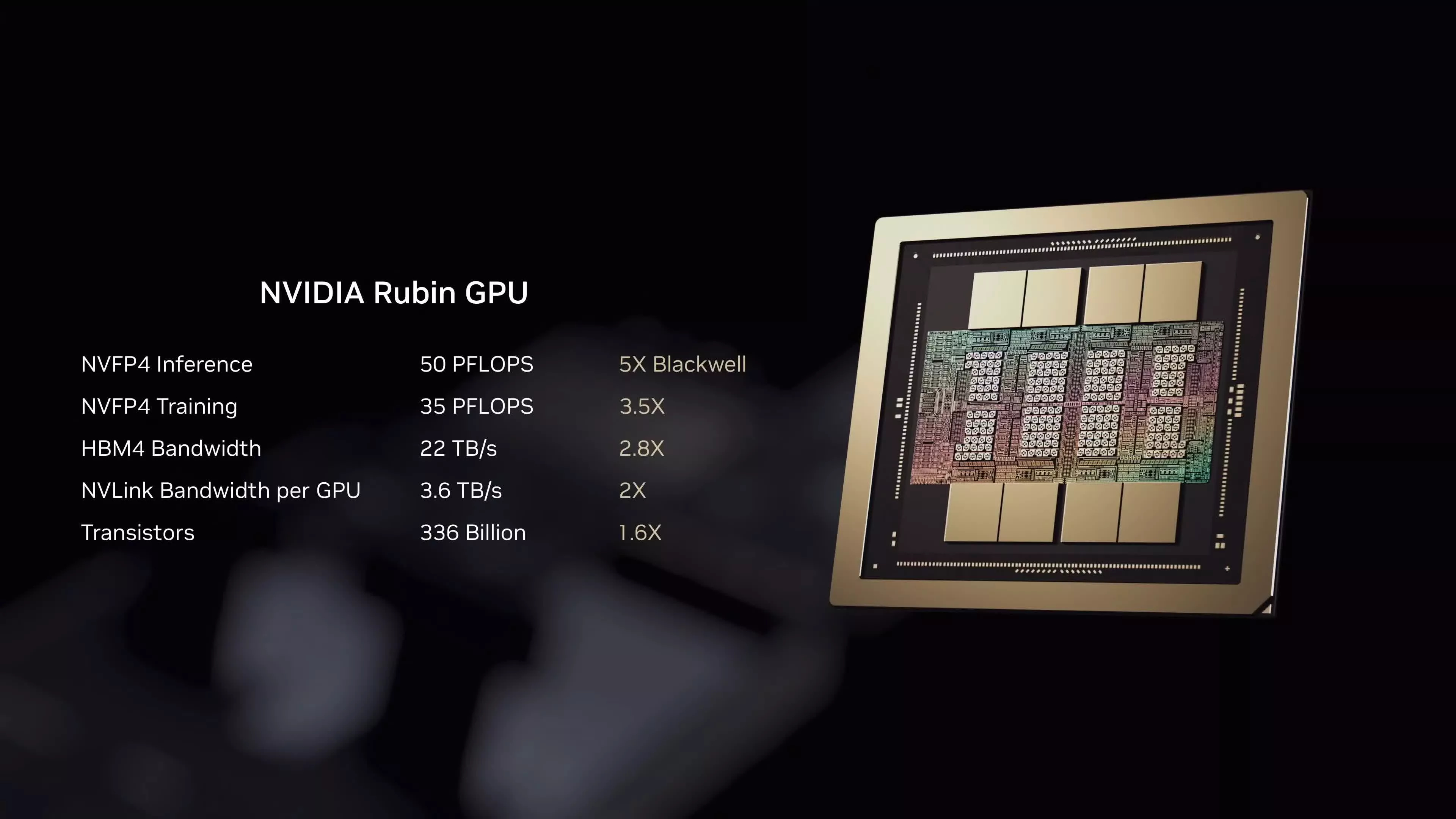
Under this scenario, Rubin parts would carry "GR20x" die identifiers – such as "GR202" for the flagship – and target GPU frequencies in the high-2 GHz to low-3 GHz range. That would translate into relatively modest clock gains over today's Blackwell-based GeForce hardware.
Feature-wise, Rubin is expected to introduce 6th generation Tensor cores and 5th generation RT cores. The updated Tensor blocks, paired with higher overall compute throughput, are expected to improve neural rendering and could help bring DLSS 5 (so far demonstrated using two RTX 5090 GPUs) within reach of a single card, potentially expanding support beyond flagship models.
Meanwhile, the next-gen RT cores are said to target a doubling of real-time path tracing performance compared to the RTX 50 series.
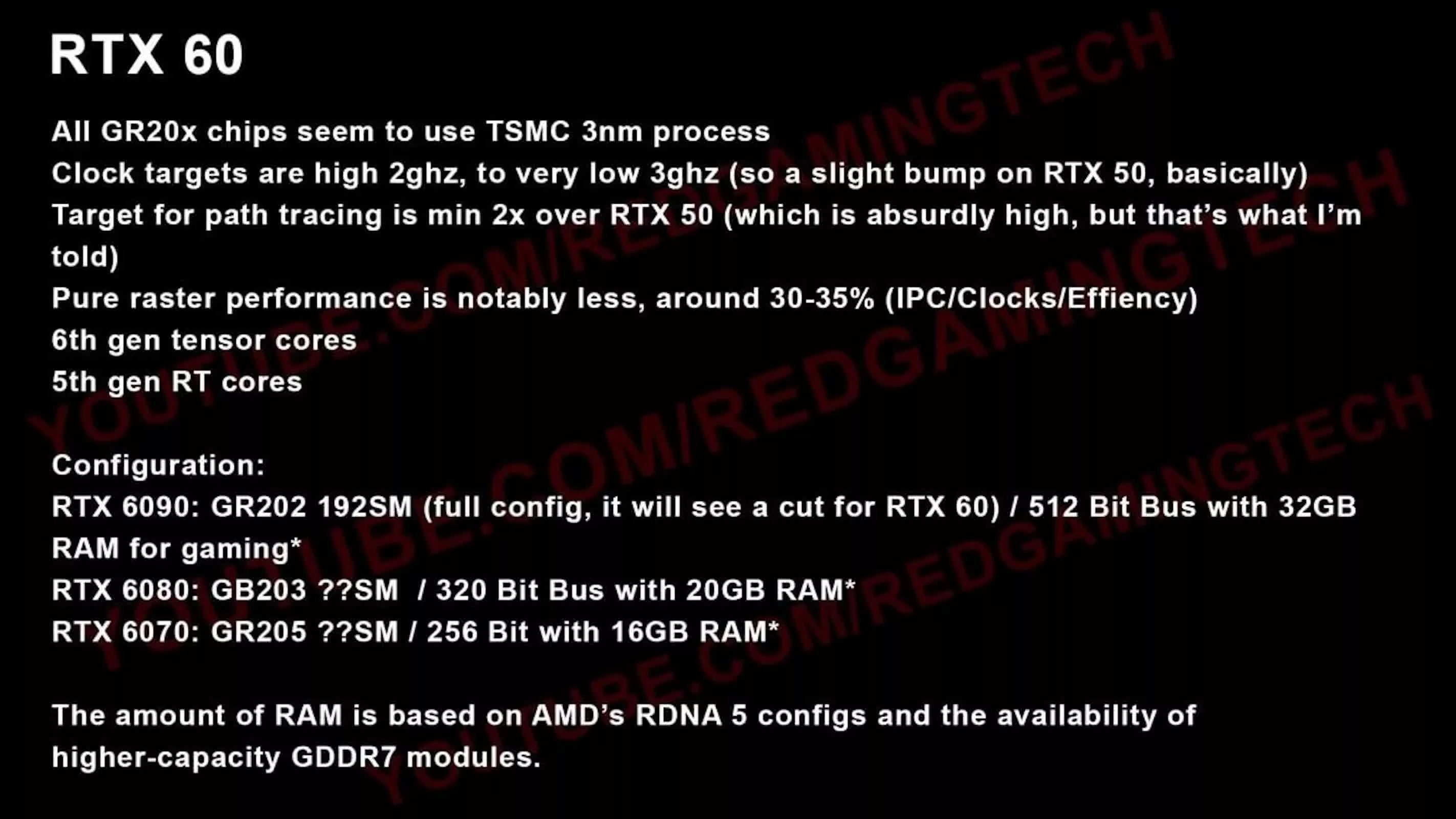
Rasterization gains, by contrast, are expected to be more incremental. Leaks point to SKU-to-SKU improvements in the 30-35% range over Blackwell, driven by architectural refinements, higher clocks, and efficiency gains from the 3nm node rather than major increases in die size.
Memory configurations could see more meaningful shifts. A rumored RTX 6090 based on "GR202" would retain a 512-bit GDDR7 interface, feature 192 streaming multiprocessors on the full die (with some disabled on shipping cards), and pack 32 GB of memory, potentially with faster GDDR7 speeds to push bandwidth higher.
A supposed RTX 6080 built around "GR203" is described with a 320-bit GDDR7 bus, 20GB of memory, and at least 25% more bandwidth than the RTX 5080. Further down the stack, a "GR205" RTX 6070 is rumored to move to a 256-bit GDDR7 interface with 16 GB of memory, delivering a bandwidth increase of at least one-third over its predecessor.