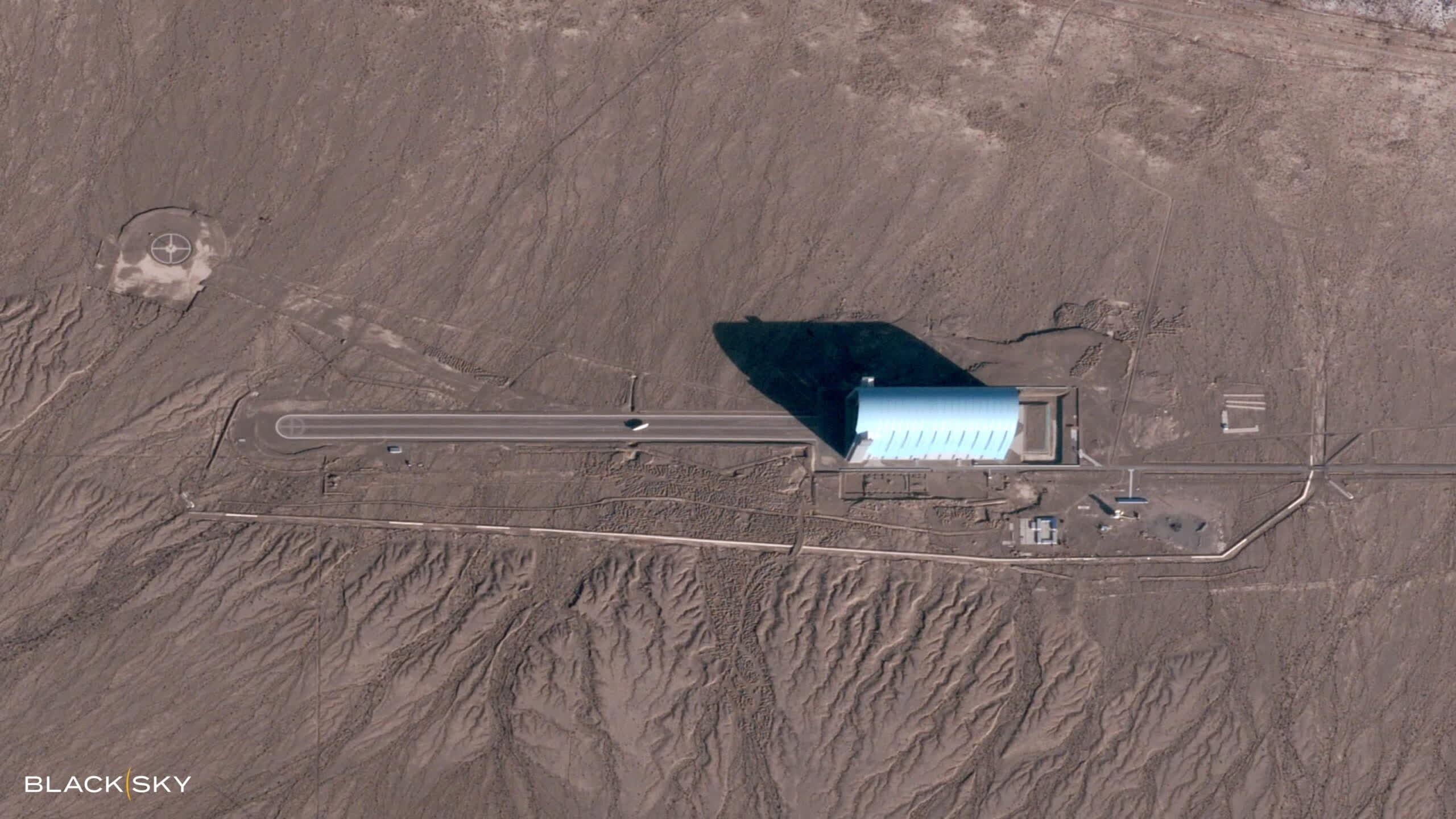
In brief: BlackSky recently announced a new contract with the US government. Washington authorities will pay the aerospace company a substantial sum to develop advanced space surveillance capabilities, including monitoring applications for both Earth orbit and cis-lunar space.
The US government has selected BlackSky to design and build the next generation of its space surveillance capabilities. The newly announced contract is an indefinite delivery/indefinite quantity (IDIQ) agreement, meaning the company will provide as many satellites and monitoring services as the Air Force Research Laboratory requires for its missions.
BlackSky specializes in real-time, AI-enhanced, space-based intelligence and surveillance services. It is building a constellation of imaging and reconnaissance satellites, offering its services to both national governments and commercial clients worldwide. The company develops and manufactures its own software and hardware architectures, including the recently deployed Gen-3 satellite for high-resolution imaging applications.
Gen-3 satellites are already capable of capturing highly detailed images, providing precise data and imagery of vehicles, buildings, and people across the globe. Under the new IDIQ contract, future generations of BlackSky's orbiting payloads will further enhance the remarkable capabilities of the Gen-3 platform.

Washington will pay the Herndon, VA – based corporation $99 million, starting with an initial $2 million investment to launch the first major project under the IDIQ contract. BlackSky previously announced the development of a large-aperture optical payload for Earth observation, as well as the Aros satellite platform for multi-spectral data collection.
The IDIQ contract will cover Gen-3, Aros, and more advanced satellite payloads. According to BlackSky CEO Brian O'Toole, the core technology in the Gen-3 satellites is scalable and can support the incremental advancements outlined in the company's roadmap.
What will the US government do with BlackSky's monitoring satellites? The company's press release highlights high-resolution imaging and data collection, low-latency space-based digital communications, and other applications. BlackSky operates on a deeply integrated business model, which combines a proprietary software platform, in-house satellite manufacturing, and compatibility with current and future launch vehicles.
The new satellites are expected to function as both data storage nodes and processing hubs, providing compatibility with upcoming space-based data centers. While technological automation is reshaping work on Earth, companies in the space sector and AI startups are actively developing the space data center concept to support future intelligence, communication, and computing applications.